Ad Disclosure
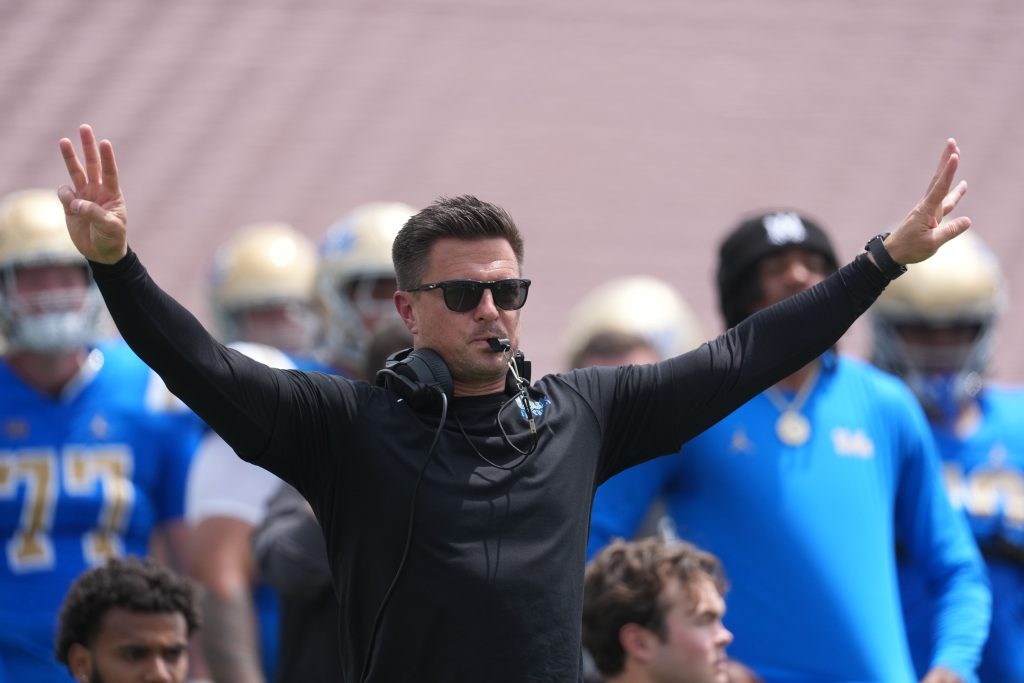

There’s a short list of powers who live above the fray in the Big Ten, like defending national champion Indiana and like the previous season’s national champ, Ohio State. Put Oregon in that group, too, and throw USC and Michigan in there while you’re at it.
But entering this season, the other 13 teams in the league are subject to a potential rise or dip on the Big Ten totem pole. As Big Ten Media Days approach, here are 3 programs poised to ascend, and 3 programs poised for a fall in 2026:
Poised to rise
We’ll start on a positive note with the programs primed to be better than they were in 2025.
1. Penn State
Last season was finally supposed to be Penn State‘s time after its impressive run to the College Football Playoff semifinals in 2024. James Franklin hadn’t won The Big One yet, but at least he’d won a couple Playoff games and got the Nittany Lions to the Big Ten title game. Penn State was the preseason No. 2 in 2025, and everything seemed in place for that first natty since 1986.
Then the 2025 season happened, Franklin was fired a few weeks before Halloween, and Penn State needed to win its final 4 games just to get to 7-6. But then came a spirited offseason in State College, highlighted by the hiring of Matt Campbell as head coach. Campbell is the winningest coach in Iowa State history, and while Iowa State will never be confused with Ohio State, that fact has to count for something very real as fall camp gets ready to open in Happy Valley.
You know what else is real? How about the 16 Iowa State transfers who’ve come along with Campbell, highlighted by quarterback Rocco Becht. He has the potential to instantly be one of the Big Ten’s top signal-callers, which is saying something in 2026. All those Cyclones turned Nittany Lions in the Ames-to-State College pipeline know Campbell’s system, on offense and defense, inside and out. That has to count for something very real, too, as does a very favorable schedule that doesn’t include Indiana, Ohio State or Oregon.
2. UCLA
Like at Penn State, there is a new man in charge in Westwood in 2026, and he happens to come from James Madison. Bob Chesney has won everywhere he’s been, capped by a 21-6 record during a 2-year run at James Madison, where he replaced a guy named Curt Cignetti. The Bruins are betting on the James Madison blueprint being the answer to a program malaise that’s landed UCLA in college football purgatory.
That guy Cignetti went 52-9 in his 5 seasons at JMU before handing the baton to Chesney. And that guy Cignetti has done pretty well so far in handling the big leap from the Sun Belt to the Big Ten, as the still-celebrating folks in Bloomington would agree. Does that mean Chesney is going to have UCLA in the Playoff in his first season in the Big Ten, as Cignetti did? We’re not saying that.
But there is enough talent there for Chesney, who was in the Playoff last season after leading the Dukes to the Sun Belt crown, to steer the Bruins from the 3 wins they mustered last season to, say, a 6- or 7-win plateau and a bowl appearance. Chesney’s arrival should no doubt light a fire under quarterback Nico Iamaleava, who faces a prove-it-or-bust situation this fall after a first season at UCLA marred by inconsistency and coaching instability. With new OC Dean Kennedy following Chesney from JMU, Iamaleava will have a fresh voice and a fresh start as he tries to prove the naysayers wrong.
3. Maryland
Malik Washington teased Terps fans with glimpses of stardom last season, and he threw for just under 3,000 yards and ran for just over 300 yards. Those numbers are nothing to sneeze at, but Washington couldn’t turn yards into points, as Maryland averaged only 23.5 points per game in 2025. That placed the Terps 95th nationally in points per game, which isn’t going to get it done when Maryland’s margin for error is already so slim.
A running game that finished 122nd nationally last season didn’t help Washington much either, and that’s been Maryland’s point of emphasis in the offseason. Head coach Mike Locksley brought in new offensive coordinator Clint Trickett, who’s known for building physical rushing attacks, so maybe the Terps can punish teams a little in 2026 instead of getting punished. Maryland also brought in some transfer running backs to complement Trickett’s system, including Harry Dalton III from USC.
Questions remain at wide receiver, as in, do the Terps even have a No. 1 wide receiver? But Trickett’s influence should still help Washington grow, and on the other side of the ball Maryland brought in 4 transfers to beef up its already talented defensive line. Like UCLA, when talking about a rise for Maryland in 2026, we’re talking about a bump from 4-8 in 2025 to bowl eligibility in 2026. And a push up the Big Ten ladder from last season’s 1-8 mark should be in order as well.
Poised to fall
It could very well be a disappointing 2026 season for this Big Ten trio that’s scrambling for relevancy.
1. Michigan State
A proud program that’s suffered through 4 straight losing seasons didn’t have to search too far for the guy it hopes will turn things around. Michigan State stayed in the Big Ten family and brought in Pat Fitzgerald, the longtime head coach at Northwestern. After 3 years away from head coaching, Fitzgerald returns with a massive task in trying to make the Spartans relevant again.
He might yet do it, because we’re talking about an intense guy who had a winning record in 17 seasons at a program like Northwestern, where he also starred as a player. Fitzgerald’s first task in East Lansing will be rebuilding in the trenches, particularly on offense, where he brought in former Alabama OC Nick Sheridan to run the Spartans’ offense.
Fitzgerald also inherits a defense that posted a meager 22 sacks last season, with no Spartan posting more than 2.5 sacks. A guy with a defensive pedigree like Fitzgerald probably isn’t going to allow defense to be an issue for too long. But this feels like a scenario in 2026 where Michigan State takes a step back before Fitzgerald begins the inevitable ascent in 2027. Fitzgerald brought in a whopping 32 players from the transfer portal this offseason with 45 players leaving, so logic says that amount of turnover might demand 1 grueling season to sort it all out.
2. Rutgers
Greg Schiano has found the sledding a lot tougher at Rutgers during his second stint there this decade. After leading the Scarlet Knights to great heights in the 2000s, highlighted by that special 11-2 campaign in 2006, Schiano is a combined 31-41 in Piscataway since taking over again in 2020. Greg Schiano hasn’t been able to lift Rutgers out of mediocrity in 6 seasons, and it’s going to be really difficult for anything drastic to change that in 2026.
Rutgers has its leading rusher back from last year in Antwan Raymond, and wideout KJ Duff returns after a 60-catch season. Offensive weapons shouldn’t be a problem, nor should quarterback with Boston College transfer Dylan Lonergan or AJ Surace taking over. But the offensive line could be a problem, especially with tackle Taj White transferring to Colorado, and more questions on the O-line after shaky play last season isn’t exactly a ticket back to bowl eligibility.
Another thing that could bog down the Scarlet Knights? The run defense, which was abysmal last season, as Rutgers surrendered a ridiculous 210 yards per game and almost 7 yards per carry. Are there enough reinforcements on the way to fix it in 1 offseason? And will new defensive coordinator Travis Johansen, the former South Dakota head coach, really be the answer? There’s a decent amount of talent for Schiano, but probably even more questions, and that alone could mean a slight dip in a loaded Big Ten.
3. Northwestern
Chip Kelly’s last foray into the Big Ten as an offensive coordinator ended up pretty well, as he helped Ohio State win a national title just 2 years ago. But that was Ohio State, with one of the most stacked offenses in college football history. This is Northwestern, with its seemingly never-ending fight to escape mediocrity, and Michigan State transfer quarterback Aidan Chiles brings plenty of potential but also plenty of questions. Can Kelly have enough of an immediate impact on Chiles’ level of play?
Kelly will have last season’s leading rusher, Caleb Komolafe, at his disposal this fall, but there are question marks at wide receiver and on the offensive line. This feels like a scenario where Kelly squeezes as much as he can out of this offense in Year 1 before his effect is truly felt in 2027.
The loss of edge rusher Anto Saka to Texas A&M isn’t going to help matters in the trenches, where the Wildcats’ pass rush already needed help. The return of star safety Robert Fitzgerald, Northwestern’s leading tackler last season, will help in a pretty stacked secondary, but guess what else is stacked at Northwestern in 2026? The schedule. David Braun is 19-19 so far in Evanston, and don’t just count on Kelly as the savior who’ll automatically get the Wildcats to a second straight bowl game.

Like our coverage? Make Saturday Tradition a preferred source in your searches!