Ad Disclosure
Big Ten Men’s Basketball Player of the Year: Top 6 Contenders

By Adam Spencer
Published:
The Big Ten has been one of the deepest and most competitive conferences in the country in 2025-26, with a logjam of elite teams at the top and a wealth of individual talent to match.
Picking a Player of the Year is no easy task in a league where Michigan is 15-1 in conference play and 4 teams are tied with 4 losses in conference play.
We’ll break the 6 most compelling cases, but first, we’ll give honorable mentions to the following players:
- Nick Martinelli, Northwestern
- Bruce Thornton, Ohio State
- Morez Johnson Jr., Michigan
- Pryce Sandfort, Nebraska
And now let’s dive into the top 6:
No. 6: Nick Boyd, G, Wisconsin
19-8 overall | 11-5 B1G | 20.6 PPG | 3.6 RPG | 3.8 APG | 48.0 FG% | 36.2 3P% | 81.3 FT%
Nick Boyd has been the engine of one of the Big Ten’s most consistent teams, and his combination of scoring, play making, and winning makes him a legitimate Player of the Year candidate. The Wisconsin guard is averaging 20.6 points and 3.8 assists per game while logging 31.1 minutes per night — meaning he’s producing at an elite rate without needing to be on the floor as long as his peers. In conference play, Boyd has been outstanding, averaging 21.6 PPG and 4.4 APG while shooting 47.3% from the floor against B1G opponents.
Wisconsin’s 11-5 conference record is the best among any player averaging 20+ PPG (ahead of Thornton, Martinelli, Iowa’s Bennett Stirtz and Indiana’s Lamar Wilkerson in the standings), and Boyd has been the driving force behind the Badgers’ success. He’s scored 20 or more points in 17 of 27 games and has been remarkably consistent throughout the season. In a weaker year, Boyd would be a top-3 candidate. This season, the depth of the field pushes him to the edge of the conversation, but he absolutely belongs in it.
No. 5: Bennett Stirtz, G, Iowa
19-8 overall | 9-7 B1G | 20.6 PPG | 2.4 RPG | 4.5 APG | 1.4 SPG | 50.9 FG% | 39.4 3P% | 84.0 FT%
Bennett Stirtz is the most underrated player in the Big Ten POY conversation. The Iowa guard is shooting 50.9% from the field — the best mark among the conference’s top scorers — while averaging 20.6 points and 4.5 assists per game. He’s a true dual threat who can fill it up or set up teammates, and his 2.0 turnovers per game is solid for a guy handling the ball as much as he does. In conference play, Stirtz has been even better, posting 23.4 PPG and 3.8 APG while shooting 51.8% from the floor. That’s the highest conference scoring average of any player in this group.
The knock on Stirtz is Iowa’s 9-7 conference record — respectable, but not elite in a league this deep. The Hawkeyes have been a bubble team rather than a contender, which limits his case against players on 12- and 15-win conference squads. Still, the efficiency numbers are impossible to ignore, and his conference scoring average of 23.4 PPG is the best of anyone on this list. In a different year, Stirtz would be the clear-cut winner.
No. 4: Braden Smith, G, Purdue
22-5 overall | 12-4 B1G | 14.9 PPG | 3.8 RPG | 8.7 APG | 1.9 SPG | 47.5 FG% | 41.2 3P% | 80.7 FT%
Braden Smith doesn’t fill up the scoring column, but he may be the most indispensable player on one of the Big Ten’s best teams. His 8.7 assists per game rank among the elite playmakers in the entire country, and in conference play he’s averaging 8.3 APG while shooting a highly efficient 50.5% from the field. Smith is the engine that makes Purdue‘s offense hum — a high-IQ point guard who keeps turnovers manageable (2.9 per game) despite handling the ball on virtually every possession. The Boilermakers are 12-4 in the Big Ten and 22-5 overall, and Smith’s fingerprints are all over that success. His case for POY is a pure winning matters argument: he may not be the flashiest name on this list, but few players in the conference have contributed more to their team’s bottom line.
Can Purdue go on a run to the Final Four? The Boilermakers have a 15% chance of making it to the national semifinals in Indianapolis, per Kalshi:

No. 3: Jeremy Fears Jr., G, Michigan State
22-5 overall | 12-4 B1G | 15.0 PPG | 2.5 RPG | 9.2 APG | 1.3 SPG | 43.0 FG% | 28.6 3P% | 90.8 FT%
If Braden Smith is one of the Big Ten’s best playmakers, Jeremy Fears Jr. is the best. His 9.2 assists per game lead the entire conference and place him among the nation’s top distributors, and in conference play he’s averaging 8.9 APG against the B1G gauntlet. Fears is the heartbeat of a Michigan State team that is 12-4 in the conference and 22-5 overall. His 90.8% free throw shooting is the best among all 6 candidates, and his ability to get to the line and convert is a critical weapon in close games. The knock on Fears is his 43.0% field goal percentage and modest scoring average, which will cost him votes against players putting up nearly 20 points per night. But in terms of pure impact on winning, it’s hard to argue with what he’s done for the Spartans. He edges Smith out on the strength of his APG lead and Michigan State’s identical record.
No. 2: Yaxel Lendeborg, F, Michigan
25-2 overall | 15-1 B1G | 14.6 PPG | 7.5 RPG | 3.2 APG | 1.2 SPG | 1.5 BPG | 49.8 FG% | 82.1 FT%
Yaxel Lendeborg’s case for Player of the Year rests on 1 fact: he plays for the best team in the Big Ten, and arguably the best team in the country (though Duke just made its own case on Saturday night). Michigan’s 15-1 conference record is in a class of its own — 3 full games ahead of the next tier in the loss column — and Lendeborg is the anchor of that machine. The forward does a little bit of everything: he scores efficiently (49.8 FG%), rebounds at an elite level (7.5 RPG, 7.8 in conference play), distributes (3.2 APG), and protects the rim (1.5 blocks per game, the best among all 6 candidates). In conference play, he’s averaging 14.3 PPG, 7.8 RPG, and 3.3 APG while shooting 45.4% from the floor.
The honest debate around Lendeborg is whether his numbers are impressive enough to win a POY award even with the best team record in the league. His scoring average is the lowest of the 6 candidates, and voters who prioritize individual production will look elsewhere. But Michigan doesn’t go 15-1 in the Big Ten without him, and that kind of winning impact is exactly what a conference award should recognize.
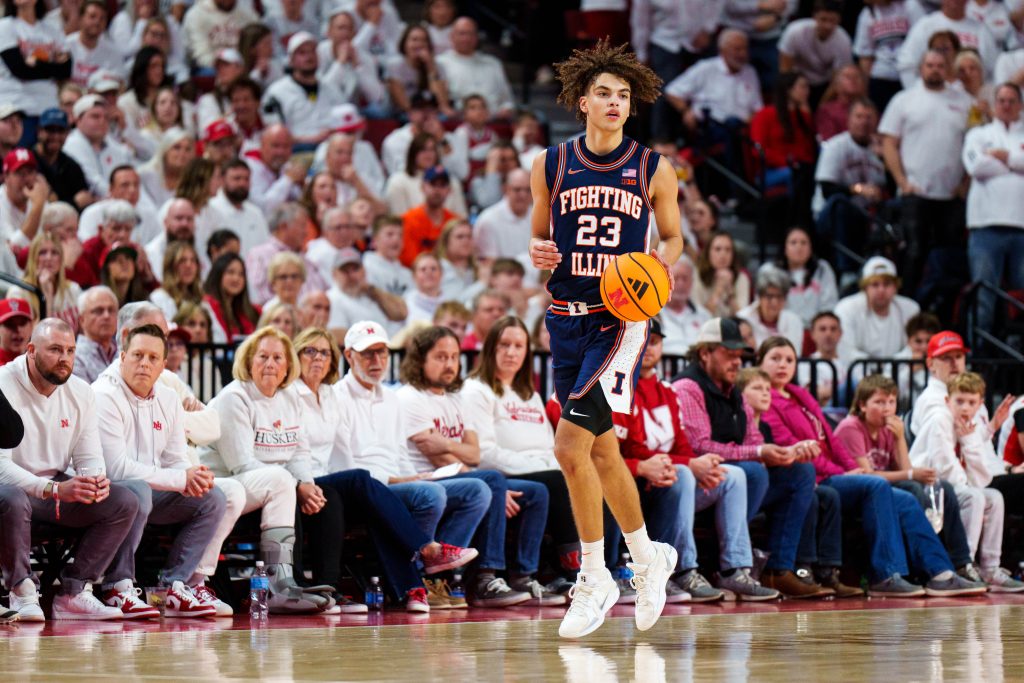
No. 1: Keaton Wagler, G/F, Illinois
22-6 overall | 13-4 B1G | 18.2 PPG | 5.0 RPG | 4.3 APG | 45.6 FG% | 42.0 3P% | 81.3 FT%
Keaton Wagler is the Big Ten Player of the Year, and the case is built on the most important factor in any conference award: winning.
Illinois is 13-4 in the Big Ten — the best conference record among any team with a top POY candidate outside of Michigan — and Wagler arguably has done more for the Illini than Lendeborg does for Michigan. His numbers don’t jump off the page the way Stirtz’s or Boyd’s do on the scoring end, but the totality of his game is unmatched in the conference.
He scores (18.2 PPG), rebounds (5.0 RPG), distributes (4.3 APG), and shoots from deep (42.0% from 3). In conference play, Wagler has elevated his game even further, averaging 20.7 PPG, 4.4 RPG, and 5.1 APG against league opponents — the best all-around conference stat line of any player in this group.
What makes Wagler’s case truly special is his versatility. He’s the rare player who can take over a game as a scorer, run the offense as a playmaker, or knock down a critical 3 when Illinois needs a bucket. His 1.7 turnovers per game is excellent for a player handling the ball as much as he does. Illinois is a legitimate Big Ten Tournament title contender, and Wagler is the reason why. Guards win in March, and Wagler looks ready to lead the Illini into the postseason in style. In a conference full of elite individual performers, he’s the one who has done the most to win games, and that’s what the Player of the Year award is all about.
Will Michigan or Illinois end the Big Ten’s title drought during this year’s NCAA Tournament? The Wolverines are trading at 22 cents per contract on Kalshi, while the Illini are at 7 cents per contract:
A 2012 graduate of the University of Missouri, Adam is the news editor across all Saturday Football brands.