Ad Disclosure

UCLA is John Wooden and Westwood wizardry, wrapped in regal college basketball lore with loads of hardware to show for it.
The school’s steep tradition in college basketball is so immense that Bruins faithful could be forgiven if they annually gave football a passing glance in September and October before storming venerable Pauley Pavilion each November. Just Wednesday night, those 9th-ranked basketball Bruins added to that illustrious roundball history, dispatching Arkansas-Pine Bluff by 69 points, an all-time UCLA record for margin of victory.
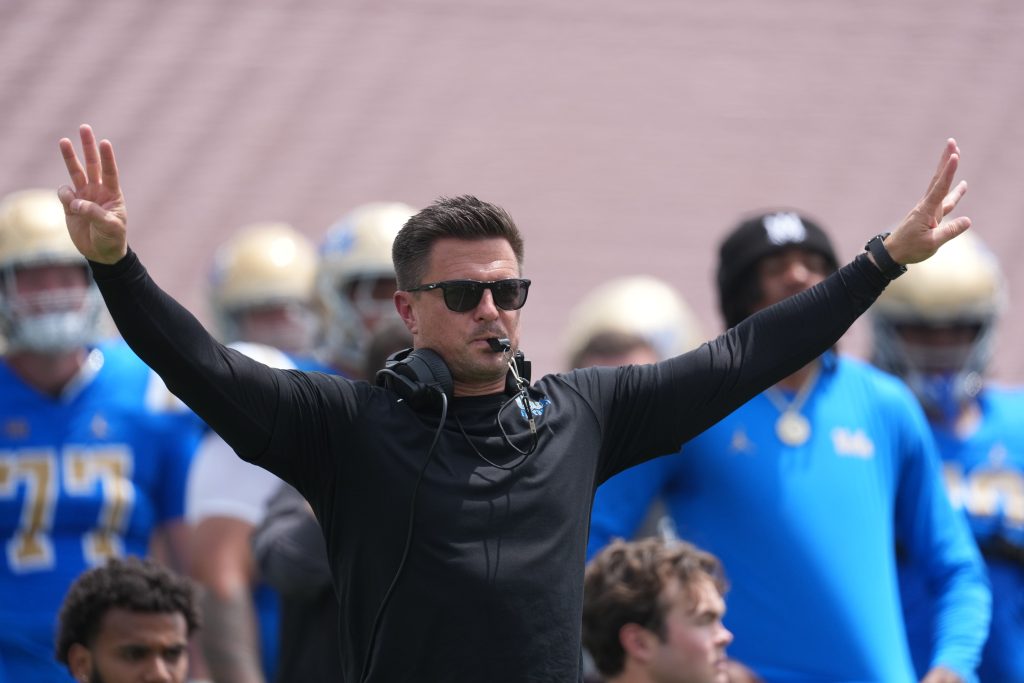
But before those surging Bruins play another basketball game next Monday night, UCLA’s fandom will feast its eyes on a Bruins football team that nobody can take their eyes off of. It’s the middle of November and UCLA isn’t just relevant in football — it sits at No. 4 in both major polls, at No. 4 in the College Football Playoff rankings and astonishingly still hasn’t lost a game under a new head coach with a brand-new mindset.
With arguments only possible from the good folks in Salt Lake City, UCLA is the so-far story of the 2026 college football season as Thanksgiving sits a few weeks away. Ohio State doesn’t lead the Big Ten and neither does Oregon, and even defending national champion Indiana is playing second fiddle to Bob Chesney’s magical Bruins, who are 9-0 overall with a 6-0 mark in the Big Ten.
This is all kind of crazy, but it’s definitely reality. Can Chesney’s first-year fairy tale continue? The next challenge awaits on Friday night at another venerable UCLA venue, the Rose Bowl, where a pretty good 6-3 Illinois team comes to Pasadena for a nationally televised 9 p.m. ET showdown on FOX. The spotlight will shine on these Bruins, who are gaining confidence with each win, but who also have plenty of work left to go the distance in the Big Ten.
Can they? Maybe and maybe not. But here are 3 reasons to believe in these Bruins as Week 11 arrives:
1. An elite running attack that leads the Big Ten by a mile
What’s been UCLA’s perfect solution all fall for a passing offense that ranks 13th in the Big Ten?
A dominant running game, of course.
The Bruins have bulldozed opponents on the ground this season, which has allowed them to set the tone and the tempo during their 9-0 start. Big Ten foes haven’t been able to do a darn thing.
UCLA has run the ball down opponents’ throats in 2026 to the tune of 213.22 yards per game, which is tops in the Big Ten by a wide margin. Northwestern ranks 2nd in the league in rushing but averages a full 23 yards less than the Bruins, who have piled up a whopping 1,919 yards on the ground through 9 games thanks to the trio of Wayne Knight (789 yards, 13 touchdowns), Anthony Woods (524 yards, 6 TDs) and Jaivian Thomas (271 yards, 4 TDs).
Knight and Woods both average over 6 yards per carry, which is remarkable considering they play in the Big Ten, considering their amount of carries this deep into the season and considering how much opponents are keying on UCLA’s running backs.
With original starting quarterback Nico Iamaleava done for the season with a torn ACL and fill-in Ty Dieffenbach playing steady if not spectacular football, it’s been that brute force of a running attack that’s carried the offense and carried UCLA to within 3 victories of a 12-0 regular season.
Second-year running backs coach AJ Steward has helped build an elite running game that just might catapult the Bruins into the Playoff and has them on the cusp of a most unlikely Big Ten crown. Steward’s brand of coaching under Bob Chesney has everything to do with football and a specific mindset, and with Steward and run game coordinator Chris Smith at the controls, UCLA has already come a long way in a short time.
With this ridiculously good running game, it can surely rule the Big Ten in 2026 and, just maybe, take things a lot further.
2. An opportunistic defense that can stop the run and pass
OK, so UCLA can run the ball with the best of them, and so far, way better than anybody else in the Big Ten. But what makes this Bruins team so dangerous going into mid-November is its ability to pound teams into submission while also being able to shut them down with a well-balanced defense.
Going into Week 11, which is a huge sample size, UCLA ranks 3rd in the Big Ten in scoring defense (14.1 points per game), 3rd in rushing defense (87.67 yards) and, yes, 3rd in passing defense (177.0 yards). That’s a trio of reasons the Bruins’ success can certainly hold up through November, into December and the Big Ten Championship Game and just maybe into January.
And why not? Look at how far this defense has come just this season.
Since allowing 38 points to Purdue in the 3rd game of the year, UCLA has given up a remarkable 55 points combined in its past 6 games. That kind of defensive consistency wins games, and together with that running game it’s a winning formula that has boosted these Bruins into the Big Ten penthouse this deep into the season.
What Colin Hitschler has done in his first season as UCLA defensive coordinator has been off the charts. He’s tasted the college football big time, as co-DC at Alabama in 2024, and he’s recently coached in the Big Ten, as Wisconsin‘s co-DC in 2023, but then it all comes back to Bob Chesney, doesn’t it?
Hitschler was the defensive coordinator at James Madison last season under Chesney, and that continuity has carried over to the Big Ten and to UCLA in 2026. It’s no accident that the Bruins lead the Big Ten in something else — turnover margin, at plus-14. They’ve forced 27 turnovers in 9 games, which is 3 per contest and a heck of a way to flip field position and create short fields for that ground-controlled offense.
The winning defensive formula has been in action since early September. Why can’t it continue for just a little longer?
3. A belief and culture built on the fly by Bob Chesney
When UCLA goes from Big Ten afterthought to late-season Big Ten leader in the blink of an eye, there has to be something vastly different thrown into the pan that’s making it all cook so well, so fast.
There is, and it’s Chesney, who is performing the same James Madison Way culture transplant that his predecessor at JMU, Curt Cignetti, has already pulled off at Indiana.
Chesney went 21-6 in his 2 seasons at James Madison, even getting the Dukes into the Playoff last season from the tiny Sun Belt Conference. Now, in his very first season in the college football big time, Chesney is showing that UCLA might have made the shrewdest hire since, well, Indiana lured Cignetti from James Madison 2 years earlier.
UCLA football hasn’t mattered much in a very long time, and it’s been playing for seemingly forever in the shadows of the USC football machine. While USC trudges along and Lincoln Riley tries to save his job amid Playoff pressure, Chesney has made games matter at the Rose Bowl long before the actual Rose Bowl game.
The Bruins’ firm belief and a winning culture have been concocted so quickly, you would swear that the wizardry is back in Westwood, only this time in football, and there can’t be many still doubting UCLA’s chances to go the distance.