Ad Disclosure

Let’s face it, there’s a certain degree of pressure on every program, on every head coach, during every college football season.
This is the cold, harsh truth in every conference, at every level of college football, and in the league that boasts the past 3 national champions of the sport, that pressure cooker is spiked by a few hundred degrees.
Think Indiana and Curt Cignetti can kick back and let the chips fall where they may in 2026, resting on those laurels of last season’s 16-0 dream? Yeah, right. There will be that much more pressure on Cignetti and the Hoosiers this fall to keep that roll going and prove there’s staying power in Bloomington.
What about the previous season’s national champ? Think Ryan Day can just tell those scarlet-faced crazies in Columbus that, hey, the champagne smell still hasn’t disappeared from that 2024 natty celebration? Plainly put, there is maximum pressure on Ohio State to win it all, like every year, and the Buckeyes didn’t win it all in 2025.
From the programs presently living in the penthouse of the Big Ten to the cellar dwellers desperately trying to make their way up, there is pressure to succeed. But let’s also face it — there are some Big Ten programs who enter the 2026 season with a little (or a lot) more heat on them than others, for whatever reason, for whatever stage they’re at right now. Here are 5 programs from the current conference of football champions who fit that ever-stressful bill:
1. Oregon
When Dante Moore spurned the NFL Draft and decided to return to Eugene for another season, it immediately put everyone on alert. The Big Ten went on alert, the rest of college football went on alert and Oregon itself went on alert. For every other team in the land, it was a bright green-and-yellow-colored alert that Oregon would be all in to finally capture that elusive first national championship in program history.
But for Oregon, it was a different type of alert. For Oregon, it was a “now or never” kind of signal, that the 2026 Ducks would carry the burden of being the Big Ten’s latest national-champ-in-waiting. In golf, the label of being the “best player to never win a major” isn’t a welcome one, and in college football there are the “best programs to never win a natty,” an unfortunate list that Oregon headlines. The Ducks have been good for seemingly forever but never quite good enough to be the last team standing.
The past 2 seasons have seen Oregon get close before flaming out in the College Football Playoff. In the 2024 season, the Ducks were the top seed but got ambushed by Big Ten rival and eventual national champion Ohio State. In 2025, Oregon was taken apart again by another Big Ten rival, Indiana, which also went on to win it all. There were 2 national title game losses, to Cam Newton and Auburn in 2010 and to Ohio State in 2014, when Oregon was still dominating the Pac-12 before its move to the Big Ten.
Oregon has been relevant for roughly 3 decades now, with an astounding 9 Pac-12 titles and a Big Ten crown in 2024 to show for it. But no national championships. Not yet at least. Could this finally be the year? Dan Lanning has gone 48-8 in his first 4 seasons in Eugene, and that success led to him having to replace both of his coordinators this season.
But guess what position Lanning doesn’t have to replace in 2026? Quarterback. Moore is back after throwing for 3,565 yards and 30 touchdowns last season, and he’s got a stacked roster surrounding him. If anything happened to Moore, Oregon even has a high-profile backup in Dylan Raiola, who transferred in from Nebraska. But the vision for long-suffering Ducks fans is for Moore to be holding that trophy in January, the trophy that Oregon hasn’t quite been able to get its hands on.
Expectations are through the roof. So is the talent level. And so is the amount of pressure that Oregon lugs into the 2026 season.
Will Oregon win its first-ever national title? Here’s what the latest Kalshi market says:

2. USC
While the pressure on Oregon centers around the entire program, the pressure in Trojan Land revolves around head coach Lincoln Riley. After going 55-10 in 5 seasons at Oklahoma, including 4 Playoff berths, it’s been a little more of a struggle in SoCal for Riley. There’s nothing wrong with going 35-18 in your first 4 seasons, unless you’re Lincoln Riley and unless you’re at a blueblood program like USC that expects to win at the highest level.
So far at least, USC hasn’t won at the highest level with Riley in charge, losing at least 4 games in each of the past 3 seasons. The bigger issue, of course, is that there have been 0 Playoff appearances so far, and Riley is well aware that that has to change very soon. Like, soon as in this season, with USC athletic director Jennifer Cohen recently telling the Los Angeles Times that the expectations are to make the Playoff this year and “to be competing for championships every single year.”
Clearly, USC didn’t give Riley a 10-year, $110 million deal when he arrived in 2022 to be playing in the Holiday, Las Vegas and Alamo bowls, the 3 bowl destinations the Trojans have ended up in the past 3 seasons. It’s just about Playoff or bust for Riley in 2026, and fortunately USC has one of the best quarterbacks in the country in Jayden Maiava to help it finally get there. Maiava lost a lot of his weaponry to the NFL, but there is plenty of talent coming back as these Trojans (and Riley) deal with all the pressure.
It would be disrespectful to not mention the pressure that LA rival UCLA is under this season with first-year head coach Bob Chesney, who inherits a talented quarterback in Nico Iamaleava who’s under extreme pressure himself to do a lot better than the 3-9 record the Bruins had last season. But it would also be disrespectful to compare UCLA’s pressure to USC’s. It’s apples and oranges, and Riley’s Trojans will be challenged by a Big Ten schedule that includes each of the Big 3 in Oregon, Ohio State and Indiana.
It’s USC’s job — Riley’s job — to push itself into that pantheon of Big Ten elite by the close of the 2026 season, with that elusive Playoff spot included. Riley’s job itself might just be dependent on it.
3. Michigan
The pressure that will exist this fall in Ann Arbor is a direct compliment to Kyle Whittingham and what he was able to do over a long period of time at Utah. Going 177-88 over 2 glorious decades in Salt Lake City carries a lot of weight, and now there will be a weight on Whittingham’s shoulders to recreate that winning formula at The Big House and in the Big Ten.
When the Sherrone Moore scandal hit last December, Whittingham’s sudden availability provided a soft landing for Michigan and an instant opportunity to rebound on the fly with a well-known name in the college football coaching world. But that 2023 national championship season is still fresh in Michigan fans’ minds, and there is plenty of angst in Ann Arbor to get back to the mountaintop after seeing hated Ohio State win it all the next season and Indiana, of all programs, get there last year.
A lot more is expected of quarterback Bryce Underwood after a bit of an underwhelming freshman season, and Whittingham brought in Jason Beck, his offensive coordinator from Utah, to get a lot more out of Underwood this fall. The stain from the Moore scandal will linger at Michigan until (or if) Whittingham can wipe it clean with a lot of wins in 2026, and observers will be watching Whittingham closely to see if he can win instantly at somewhere other than Utah.
Whittingham shouldn’t expect any hint of a honeymoon period, and he probably wouldn’t want one anyway.
4. Penn State
You want pressure? How about being Matt Campbell? Penn State fans scarred by years of James Franklin winning a ton of games, but hardly ever big games, are now pinning their hopes on Campbell being the guy who can finally win those big games against Ohio State, Michigan and other Big Ten rivals. Franklin’s 104-45 record in Happy Valley wasn’t nearly enough to keep everyone happy, but here comes the caravan from Ames, with Campbell arriving after a decade of success that saw him become the winningest coach in Iowa State history.
Coming with Campbell are a boatload of transfers, some 40 of them, including 24 who followed Campbell from Iowa State. One of those Cyclone converts is standout quarterback Rocco Becht. His transition should be greatly helped by already knowing Campbell’s system, but he’s going to face enormous pressure from his new, ultra-passionate audience in State College. He’s not in Ames anymore, even if he’ll be surrounded by a lot of his ex-Iowa State teammates.
This will be a whole different world, for Becht, for all those transfers and especially for Campbell, whose got an 8-year contract worth $78.5 million in one hand and the heavy weight of expectations from that intense fan base in the other as he enters a crucial first season.
5. Wisconsin
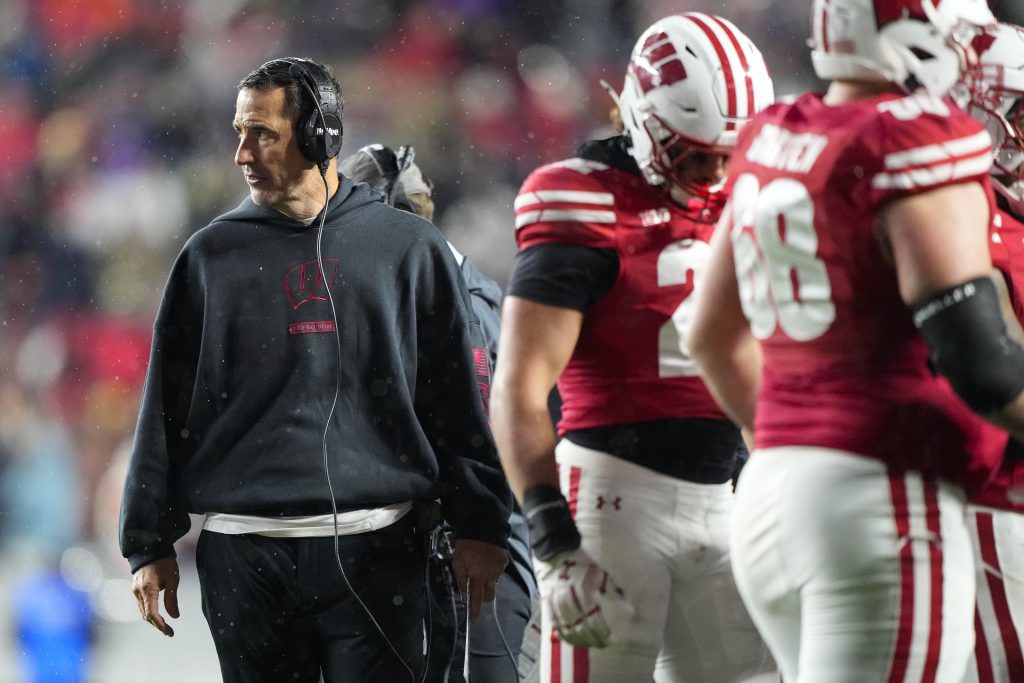
The “Fire Fickell” chants at Camp Randall Stadium arrived early last fall and never really went away. After his second straight losing season in Madison, Luke Fickell is 17-21 overall and 10-17 against Big Ten foes. That’s simply not going to fly for much longer, even if Wisconsin athletic director Chris McIntosh backed Fickell last November amid the losing while promising an increased investment in the roster and entire program.
Wisconsin has never won a national title, but the Badgers have seemingly always won. They haven’t been winning much lately though, and Fickell knows that’s got to change, starting this fall. The pressure cooker will be cranked up immediately in September, and if the losing continues, so will those “Fire Fickell” chants at Camp Randall. Desperate times call for desperate measures, and Fickell went ballistic in the transfer portal this offseason in trying to rejuvenate Wisconsin’s roster with talent that will turn into wins.
Fickell’s current contract runs through the 2031 season, and if he was fired last fall like many fans wanted, the buyout would’ve been more than $25 million. Wisconsin avoided that steep price tag, but if the losing continues in 2026, the end game on Fickell likely will become unavoidable. Fickell has been granted with another chance to get it right, and it simply must get better or else. Talk about pressure.