Ad Disclosure
Everything PJ Fleck said from the podium at Big Ten Media Days

By Ethan Stone
Published:
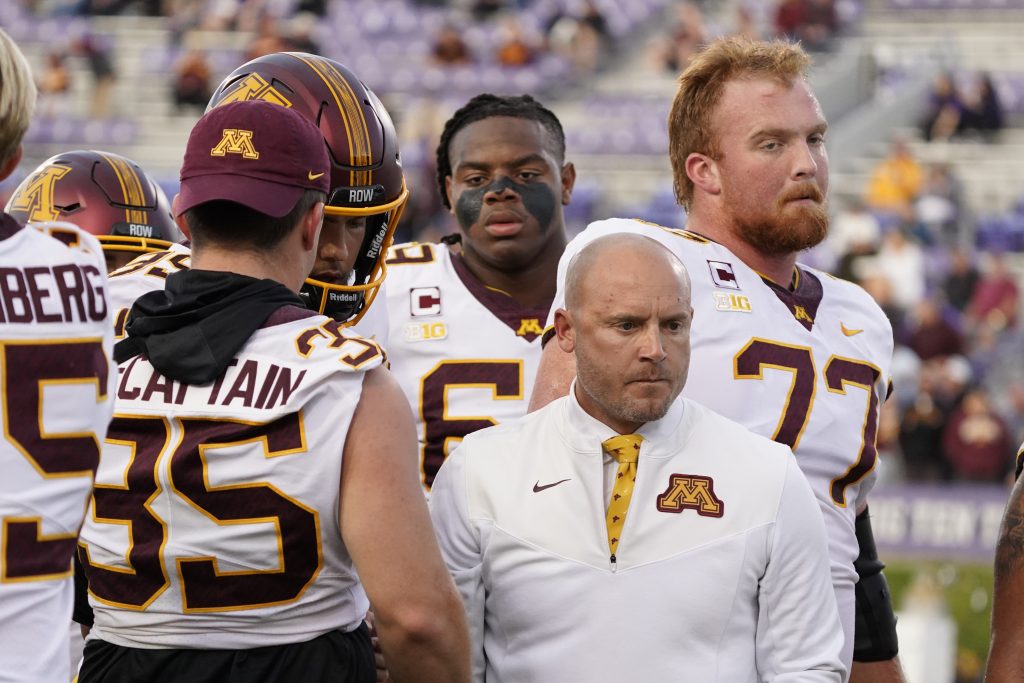
Minnesota head coach PJ Fleck was the first coach to speak on Day 2 of Big Ten Media Days from Chicago, Illinois. Here’s everything the Golden Gophers head coach had to say from the podium, via ASAP Sports:
—
P.J. FLECK: I want to thank Commissioner Petitti for his intentional leadership as he continues to lead the Big Ten as the premier conference in all of college football.
I’m excited to be back in Chicago, a place where I’m from. I got a chance to take our players out to Chicago Cut. Their administration is really. David Flom there took really good care of us.
It’s the official start of the college football season, which was really exciting for everybody.
I do want to start by two things, on a somber note a little bit. We lost a legend in the University of Minnesota coaching realm, John Anderson, our head baseball coach, who took over our baseball job in 1982 and retired in 2024, passed away this past week, elite mentor, elite coach, elite friend.
I know a lot of his players are deeply saddened by the loss. We just wish — our deepest condolences are with Jan and the entire family as they continue to heal.
On another somber note, unfortunately, my college football coach, Joe Novak, a legend at Northern Illinois University, he is Northern Illinois University football, passed away yesterday. I’ve been talking with a lot of teammates, and he taught me how to believe in people as a coach. He taught me that you didn’t necessarily need to be the biggest, strongest or fastest to play college football, hence me.
He took a lot of scrap parts and a lot of used car parts and built a football team. In fact, a really elite football team. What Northern Illinois stands on today.
I’m deeply saddened by that because he was so close to me and so close to so many others as he led the Northern Illinois football program.
Our thoughts and prayers are with Carole his wife, and his entire family as they grieve and they heal.
I do want to start by thanking my wife Heather for her unwavering support. It can be really difficult being a head football coach’s wife and a coach’s wife in general, just like our staff wives. I want to thank my kids: Gavin, Carter, Paisley and Harper.
A lot of you have asked what did we do this summer, and I think one of the greatest things to watch is our 16-year-old son Carter play baseball at a high level, watch our 13-year-old daughter Paisley, whose idol is Michael Phelps, swim and cheer, and then our 12-year-old Harper do cheer and softball. Nothing is better as a parent than to watch your kids do things that they absolutely love, and I loved doing that this summer.
I want to thank our president, Rebecca Cunningham, congratulate her and her team on the extension, and having her lead our elite institution at the University of Minnesota for many years to come.
I want to thank our Board of Regents.
Then I want to thank I think the best athletic director in America, our athletic director Mark Coyle. I want to congratulate him on a well-earned and deserved extension as well. We have the longest-tenure AD-head coach combination in the Big Ten and one of the longest in the country.
One of the reasons I love coaching at the University of Minnesota is our alignment is second to none. It’s unwavering. I appreciate his tutelage and his guidance and his friendship as we continue to take on year 10 here at the University of Minnesota.
I want to thank our general manager. It’s a popular term these days. We have the best in the business, Gerrit Chernoff, who continues to do things the right way, build elite programs through personnel and valuing what we value and really being the chief of staff of our organization.
I thank all of our staff and all the work they put in, and then especially our fans. We’ve been there 10 years. That’s a long time for a college football coach. I know that. I had hair when I took the job. I do not have hair now.
But I want to thank our fans for embracing us as Minnesotans. It means a lot to my family. I know it means a lot to our coaches’ families and our players.
We’ve been here a long time, as I said, so we’ve accomplished a lot. I’ll hit on a few things: Just 7-0 in bowl games, seven consecutive bowl games in full seasons. I think that’s really important to look at the postseason and the two seasons we have was our year one and then the COVID-shortened season.
Now, one of seven of the 18 Big Ten teams who have had back to back eight-win seasons last year and the year before. I think it just shows with the non-conference games, how hard it is to win consistently in the Big Ten, and we’ve been able to accomplish that. Only seven of the 18 teams in the league have done that.
We’ve got seven ranked wins and three in the last two years, more than any other Minnesota coaching staff. Maybe the greatest statistic I’m proud of is we don’t talk much more about the academics anymore. We don’t talk much about those.
Every single semester we’ve been there we’ve had over a 3.0. Every single semester for the last 10 years. So proud of our student-athletes because they’re still student-athletes, not professionals yet. We haven’t given them that term. Haven’t given them that name. They’re still student-athletes.
One of the greatest honors I’ve had of being a head football now is now former players coming back to work for me. We have six former Gophers on our staff, and nothing better than watching Mohamed Ibrahim, the all-time leading rusher at University of Minnesota coach our running backs. Or watch Isaac Fruechte coach our wide receivers. Or watch Mariano Sori-Marin coach our linebackers. That’s the joy of coaching, and that’s paying it forward to the next generation of coaches, who I’m very honored to do.
As we transition into 2026, we’re the only Big Ten team to bring back the head coach, the offensive coordinator, the defensive coordinator and the starting quarterback. That might not have been a big deal 10 years ago. That’s a pretty big deal right now for that cultural sustainability within the football program.
But we also have 15 new players that were not a part of our Rate Bowl championship last year, 31 high school players and 19 portal players. High school recruiting, development and retention will always be the meat and potatoes of our program. In fact, 80 percent of our players are high school players, developing within our program, including the guys we brought today.
So that’s the meat and potatoes of the diet is the high school players, mixed with, now I’m 45, I need some supplements. A little different than when I was 35.
So the supplements is our 20 percent portal players. But again, they still have to fit our program. Both are essential to the diet at the University of Minnesota.
We do have some returning portal players, which I think is really, really important. You look at John Nestor back for another amazing year, Javon Tracy, our punter Tom Weston. And then we have some guys that just got there that we’re going to rely on to really be big in our football program this year, T.J. Bush, Aydan West, Naquan Crowder. They’re going to add a ton of value to that.
Most coaches spend all off-season taking a group and making them a team. As you know me, I always break down into three categories since January all the way through the end of July of what we have to do to become a great team.
So we break it down into three areas and three points of emphasis. I always share this with you because I think it’s important. Number one, we have 112 players on our team. We have 30 states represented and seven different countries. We’ve got to make that a team as fast as possible.
When we brought up this term, E pluribus unum, which means out of many become one. It’s on our dollar bill. It’s on our quarter. You should have seen that team meeting, talking Latin to your players.
So we gave every single one of our players, because giving players money is pretty popular, we gave them a dollar bill and a quarter. I don’t think they’ve ever seen either one of those, what they actually looked like, but E pluribus unum was on there and we had a team meeting about that.
Two, we said, you’ve got to prove it now. We’ve got to put our money where our mouth is, and we’re not, no offense, proving it to the media or the external or to our fans, we’ve got to prove it to ourselves we’re exactly who we say we want to be. That’s the crack on the shoulder, proving it to yourself you’re exactly who you say, versus the chip, proving it to everybody else that you’re good enough.
So we have the dollar bill, and they wrote on that dollar bill, what are they going to prove to themselves, and then we put it in a jar for a reminder in the front of the team meeting room.
Then on the back of their workout shirts all off-season, it was their last name and exactly what they wrote on that dollar bill to hold them accountable, each other accountable. Maybe the player can’t see it but the player behind you can see it, and he’s going to hold you accountable for what you wrote down that you were going to prove it every single day to yourself and to this football team.
The third part is ETA. It’s ironic because I started my speech just with two people that are very, very close, one, to the University of Minnesota program, and then two, very close to me, that we all have an estimated time of arrival. That hourglass is always moving, people, and it doesn’t matter if you’re a coach or a player in college football, in business or in the media. It’s always moving.
So we put all these hourglasses all over our building, to remind our players the estimated time of arrival the season will be here. It was a reminder to them that we’d better get moving, and not only get moving, you’d better enjoy the adventure. That’s what ETA stands for in our program. We will never take fun out of college football and the college football experience at the University of Minnesota.
In fact, one of our best team meetings was we watched Artemis 2. Circle the moon! Crazy, right? Who would have thought. We watched that. Then we also showed a 1960s clip of John F. Kennedy saying we do things that are hard because it’s there.
Since January, whatever we want to accomplish as a team, it’s there. So why not shoot for that moon? That’s what we’re going to do.
We brought four players with us, four of our 10 captains. But I do want to mention our captains’ names because they deserve that because our leadership on our team is the best we’ve had in the 10 years I’ve been the head football coach, Jalen Smith, Greg Johnson, Ashton Beers, John Nestor, Kerry Brown and Aidan Gousby.
But the four players we brought here, you all know. Darius Taylor has been in the program four years. Drake Lindsey has been in the program three years. Anthony Smith, five years. Maverick Baranowski, five years. These are guys that have been in the program for culture sustainability since we got there.
I can’t wait for you to get around them. I can’t wait for you to talk to them. They are incredible human beings and the best of the best of student-athletes. So truly enjoy your time with them.
Can’t wait to get the season started. Thank you very much for your time. “Row the boat” and “Ski-u-Mah”, Go Gophers, and we’ll open it up for questions.
Q. I wanted to ask you about Anthony Smith. He led the Big Ten in sacks, was tied for third in the nation in sacks last year, yet you were able to convince him to stay. He could have went to the NFL, probably could have had more offers for more money had he stayed and went to a different program. How did you talk to him about staying at Minnesota, and why do you think he stayed?
P.J. FLECK: Yeah, I think that you don’t ever have to convince someone to stay. It’s just like recruiting. I don’t want anybody to come to the University of Minnesota that I have to convince or talk into.
It’s about fit and selection. We broke down exactly why he would want to be here and why he would want to leave. The funny thing is it had nothing to do with Anthony Smith. He wanted to make this team better. He wanted to experience more as a student-athlete. He knows he’s got an NFL future. They look like that. He walks into the room, you’ve seen a picture of him — not that guy, the other guy. But he walks into the room, he looks like an NFL athlete.
But Anthony is really, really smart, and he knows that 95 percent of your draft stock has nothing to do with what someone says, what this rumor is, how much money you make. It’s about your production on the football field. He wants to produce more.
Then that carried over. He’s one of the greatest human beings you’ll ever meet, one of the most eclectic human beings you’ll ever meet, and he leads our team in community service. So yes, he’s getting all these well-deserved hype before the result accolades, well-deserved. But I know Anthony probably more than any of you. He really doesn’t care. It’s flattering and it brings exposure to the University of Minnesota, but he’s got huge team goals first, and I think if you get around him, you’ll see that.
Q. You’ve had a lot of success at Minnesota, as you mentioned. You’ve won over 60 percent of your games, undefeated in bowl games, like you said. What do you feel like you need to do to take it to the next level?
P.J. FLECK: Well, first of all, as head coaches, we all stand up here, and we’re true representations of our — one, our student-athletes, but two, our coaching staffs. I think that the change your best mentality is everywhere within our building. We have to continue to win in the margins.
If you look at the successful seasons we had, we win one-possession games. If we don’t win one-possession games, we don’t have a great year, or we might have a great year, but everybody is like, oh, there was more meat left on the bone.
I think when you think of the one-possession games, like you look at last year’s team, we were 4-1 in one-possession games. Well, technically, I think maybe the ’24 team was more talented but we were 3-4 in one-possession games. And then you tie that into 78 percent, which we value in our building, which is the statistics that are really tied to winning, the ball, tackling and explosive plays. If we can be good in those three things and win those three every game and then we can win the one-possession games, we have a chance to be a really good football team.
Ethan Stone was an editor for his student newspaper at the University of Tennessee and is now a News Manager for Saturday Tradition.