Ad Disclosure
Indiana vs Oregon: The Ultimate Playoff semifinal preview & prediction

By Matt Hinton
Published:
Indiana vs. Oregon: Everything you need to know about Friday night’s Peach Bowl Playoff semifinal. Kickoff is 7:30 pm, ET on ESPN. Indiana is a 3.5-point favorite. A bold • denotes his pick in the semifinal.
When Indiana Has the Ball
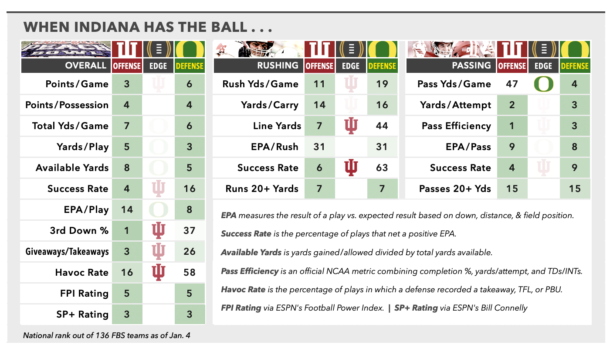
If you hadn’t seen much of Indiana prior to the Rose Bowl, you could be forgiven for assuming the offense was the Fernando Mendoza Show. Not anymore. Instead, the Hoosiers took advantage of their biggest stage ever to make a statement in the trenches, bullying Bama in exactly the kind of old-school, line-of-scrimmage romp the Crimson Tide used to inflict rather than endure. Indiana kept the ball on the ground on 43 of its 66 offensive snaps (excluding sacks and scrambles); interchangeable backs Roman Hemby and Kaelon Black combined for 188 yards on 5.7 per carry; and an offensive lineman, 5th-year center Pat Coogan, repped the entire unit as the game’s MVP, a fitting distinction. Visibly demoralized, the Tide waved the white flag at the end of the 3rd quarter, settling for the saddest field goal in Alabama history to cut a 24-0 margin to 24-3, and spent the 4th getting shoved around at will.
The Hoosiers’ success up front meant ideal conditions for Mendoza, the Heisman winner whose role in Pasadena was less leading man than designated sniper. Although he only attempted 16 passes, the results were ruthlessly efficient, yielding 14 completions, 12.0 yards per attempt, 10 first downs, 3 touchdowns to 3 different receivers, and an astronomical 250.2 passer rating. He was 4-for-4 passing on attempts of 20+ air yards, 9-for-10 when blitzed, and 5-for-6 on 3rd down, all of which moved the sticks. He converted 2 more 3rd downs on scrambles. Pound for pound, it was as convincing a vindication for Mendoza’s surging stock as he could have mustered while still coming in a tick under 200 yards passing.
“Force the Heisman Trophy winner to beat you with his arm” is not exactly a foolproof key to victory, but at a bare minimum Oregon cannot allow Mendoza to operate with that much cushion again. If there is a blueprint to beating Indiana, making the offense one-dimensional is as good a place as any to start. And it can be done, more or less.
Only 4 of the Hoosiers’ 14 wins this season have been decided by 10 points or less, but 1 thing the close ones had in common was tough sledding on the ground: The Hoosiers ended all 4 of those games — nail-biters against Iowa, Oregon, Penn State, and Ohio State — with less than 120 yards rushing (including sacks) on less than 3.5 yards per carry. By contrast, when they’ve run for 200+ yards, their average margin of victory is a staggering 41 points, and start-to-finish blowouts over Bama and then-ranked Illinois back in September are evidence enough that that trend was not confined to the bottom half of the schedule.
On paper, the Ducks match up as well as any defense Indiana has faced other than Ohio State’s. They’re coming off a shutout win over Texas Tech in the Orange Bowl, and the tale of the tape reflects a couple of units that are virtually dead even over the course of the season, both in the conventional stats as well as in advanced metrics like SP+, FPI, and FEI. The first time these teams met, a 30-20 Indiana win in Eugene in mid-October, Oregon more than held its own, limiting the Hoosiers to season-lows for total yards (326), yards per play (4.8), and 3rd-down conversions (35.7%). Memorably, the Ducks also harassed Mendoza into his only really costly mistake all year, a pick-6 interception under duress that briefly evened the score at 20 early in the 4th quarter.

Of course, even when they’ve succeeded in making him look average for the better part of 60 minutes or painting him into a corner, the one thing no one has managed to do yet is get Mendoza off the field with the game on the line. Following the pick-6 at Oregon, he responded on the ensuing drive by connecting on 6-of-8 passes for 62 yards, including the go-ahead touchdown to his go-to target in the red zone, Elijah Sarratt. That was a re-run from the previous Saturday at Iowa, when Mendoza rebounded from a late, potentially crippling INT in a tie game against the Hawkeyes to find Sarratt for the game-winner in the final 2 minutes. And it foreshadowed the pivotal moment of the Hoosiers’ regular season, a 10-play, 80-yard drive (actually 87 yards, factoring in a sack on the first play) to fend off an upset bid at Penn State, all of it coming via Mendoza’s arm.
Still, Mendoza with his back against the wall in a do-or-die situation is vastly preferable to the alternative, which up to now has been Mendoza casually putting the torch to defenses that have been softened up by the ground game, if not outright pounded into submission.
From Indiana’s perspective, the fewer balls he puts in the air, the better. It doesn’t always work out quite that neatly for the other side — see Mendoza’s near-flawless outings against Michigan State and Wisconsin without his usual run support in either game — but when the Hoosiers win the line of scrimmage they have been unstoppable.
Key matchup: Indiana WR Charlie Becker vs. Oregon CB Brandon Finney Jr.
Becker spent the first half of the season as just another random sophomore relegated to garbage time. When his number came up down the stretch, he seized the opportunity. Since the calendar turned to November, he’s hauled in 22 receptions (8 of which have fallen under the “contested catch” column, per PFF) for a team-high 461 yards, an average of nearly 21 yards per catch. That stretch includes 100-yard outings against Penn State, Wisconsin and Ohio State; Indiana’s first touchdown in the Rose Bowl; and at least 1 gain of 30+ yards in 5 of the past 6 games. It’s no exaggeration to say Becker has emerged as Mendoza’s favorite downfield target, which in the same rotation as a couple of second-team All-Big Ten picks, Sarratt and Omar Cooper Jr., is no minor feat.
Finney, a true freshman, has been a revelation in his first year on campus, although it didn’t take him nearly as long to appear on the radar. A Day 1 starter in August, he came in for second-team All-B1G honors after holding opposing QBs to a league-best 36.2% completion rate for the season, per PFF, which also cites him for zero touchdowns allowed in coverage. He made a splash in the first meeting against Indiana in Eugene, where he allowed just 1 reception on 4 targets and accounted for the pick-6 INT that kept the Ducks in the game in the second half (see above). More recently, Finney introduced himself to a national audience in the Orange Bowl win over Texas Tech, leading the highlight reel against the Red Raiders with 2 interceptions and a fumble recovery. Listed at a sturdy 6-2, 203 pounds, he’s ideally suited to post up opposite the lanky, 6-4 Becker, who barely saw the field on offense back in October. Whether Indiana bothers to put him to the test after the last time around is another story.
When Oregon Has the Ball
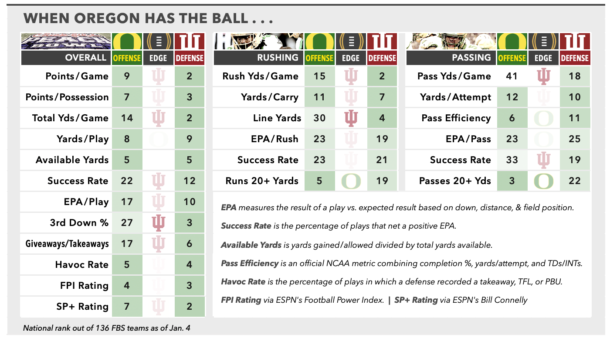
An essential part of mock draft season is settling on the pitch-perfect comparison between a rising prospect and a current pro. For Oregon QB Dante Moore, the go-to comp is former Ohio State/current Houston Texans quarterback CJ Stroud, for obvious reasons. They arrived on campus with similar hype, look similar in uniform and boast a similar skill set. Like Stroud, Moore is considered a “natural” passer with impeccably smooth mechanics when it all comes together. They throw a similarly graceful deep ball; Moore is PFF’s highest-graded passer nationally on attempts of 20+ air yards, with an FBS-best 14 touchdowns and a 62.7% adjusted completion percentage on downfield shots. (Adjusted completion percentage credits the quarterback for an accurate throw on dropped passes.) Also like Stroud, he’s proven to be a surprisingly reluctant runner with more dual-threat potential than his modest rushing stats let on.
In that vein, Moore reminds me of the college version of Stroud in another way: The alarming decline in his performance under pressure. When I wrote about Stroud ahead of his lone CFP appearance a few years back — also in the Peach Bowl, coincidentally — I compared him to a finely tuned sports car that’s not built to hold up in everyday traffic. The nagging doubts about Moore’s game fall along the same lines.
To be fair, no quarterback is immune from pressure. And in Moore’s case, the drop-off under duress is not as dramatic as Stroud’s at Ohio State. But it’s notable enough. From clean pockets, Moore ranks 3rd nationally with a 94.1 PFF grade (trailing only Heisman finalists Diego Pavia and Julian Sayin), and No. 1 with 27 “big time throws,” defined as “a pass with excellent ball location and timing, generally thrown further down the field and/or into a tighter window.” Under pressure, he falls to 51st nationally with a 53.5 grade, and with fewer BTTs (2) than INTs (3). For context, another guy with a roughly comparable gap on clean/pressured drop-backs is Alabama’s Ty Simpson, last seen wilting in the face of Indiana’s pass rush before bowing out of the Rose Bowl with a cracked rib.
The point is worth dwelling on in this matchup, specifically, because no defense has succeeded in heating up Moore more than the Hoosiers. In the first matchup, Indiana pressured Moore on 20 of his 42 drop-backs, per PFF, generating 6 sacks, 2 interceptions and a season-low 35.1 QBR rating. As a team, Oregon finished with season-lows for total yards (267), first downs (14) and points (20, including the pick-6), with its lone offensive touchdown of the game coming on a 44-yard strike from a well-protected Moore to his top wideout, Malik Benson, in the opening quarter.

That would turn out to be Moore’s only downfield completion of the game, as well as Benson’s only catch. Over the final 3 quarters, the Ducks looked increasingly like a team stuck in quicksand, until they finally stopped moving altogether.
At this point, that’s just the flat-rate Hoosier Experience.
The defense is not stocked with blue-chip specimen, future first-rounders or household names, but the week-in, week-out results speak for themselves. Like Oregon, Indiana’s other ranked opponents — Illinois, Ohio State and Alabama — also finished with season-lows on the scoreboard, managing a combined 23 points and 83 rushing yards between them. Only 1 offense to date, Penn State, reached the end zone more than once. Only Michigan State eclipsed its season average for total yards. At least the Ducks enjoyed a fleeting glimmer of success on the ground back in October before abandoning the run in the second half; now, even that seems like a long shot in the rematch with ascending freshman RB Jordon Davison on the shelf due to a broken collarbone. If there is any hope of breaking through on Friday night, it’s only by giving Moore the chance to set his feet and let it rip on a consistent basis.
Key matchup: Oregon OL Alex Harkey vs. Indiana DL Mikail Kamara
Kamara had a “disappointing” senior campaign in terms of his raw sack total, which declined from 10 sacks in 2024 to just 2 in ’25. The first came in a Week 2 blowout against Kennesaw State; it took another 4 months to record the 2nd, in the 4th quarter of the Rose Bowl. But the man did not forget how to get after the quarterback in the meantime: Per PFF, Kamara led the Big Ten for the 2nd year in a row with 54 QB pressures, despite a significant decline in pass-rushing reps as part of a deeper rotation.
He was a regular presence in the pocket in the first meeting against Oregon, leading the team-wide siege on Moore with 3 hits and 4 hurries; he also turned up the heat against Iowa (5 pressures), Penn State (8) and Alabama (6), among others. Frankly, if he were listed at 6-4 instead of 6-1, he would have already been a first-round pick, and would almost certainly still rank high in a crowded class of edge rushers coming out in 2026.
On the other side, there are no questions about the 6-6, 327-pound Harkey’s stature at right tackle. But the Texas State transfer has struggled at times with speed — most notably against Indiana, when he was singled out for a team-high 6 pressures allowed. More recently, he was also posterized on multiple occasions in the Orange Bowl by Texas Tech’s David Bailey, who picked up a sack and a holding penalty at Harkey’s expense. Of course, Bailey posterized virtually every opposing tackle he faced en route to being enshrined as a unanimous All-American. Still, as the Hoosiers are probing for weak links they know where to start. This time the onus will be on Harkey to prove he’s not it.
Special teams, injuries and other vagaries
Both teams trust their kickers, up to a point. Oregon’s spectacularly-named Atticus Sappington has connected on 33-of-39 field-goal attempts in 2 years as a Duck, including the game-winner at Iowa in wet, freezing conditions in early November. (Rest assured that even if he’d never put a single kick though the uprights, ol’ Atticus would still be bound for the All-Name Hall of Fame.) His Indiana counterpart, Nico Radicic, was a first-team All-Big Ten pick by the media after going 16-for-17 on field goals and an FBS-best 76-for-76 on PATs, but remains an unknown from long range or in the clutch; he’s yet to attempt a kick from 50+ yards or with the game on the line in his career.
Both teams have housed punts for touchdowns, although Malik Benson’s 85-yard return against USC in Week 13 is much fresher in Oregon’s mind than the Hoosiers’ entry in that column, a 91-yard house call by Jonathan Brady in the first quarter of the opener against Old Dominion. Both teams have recorded multiple blocked kicks, too, but again the Ducks have done it more recently: They rejected both a field goal and a punt in their first-round Playoff win over James Madison, returning the latter for a late, scoreboard-padding touchdown.
The injury list is short but notable. Indiana lost its most productive d-lineman, edge Stephen Daley, to a freak injury as he celebrated in the immediate aftermath of the Big Ten Championship win over Ohio State; he wasn’t missed against Alabama, but even on a front as disruptive as the Hoosiers’, there’s no magic bullet for replacing the conference leader in TFLs. As for Oregon, RB Jordon Davison’s absence comes at the worst possible time, with the depth chart having already been thinned out by the departure of 3 other scholarship backs via the portal. The Ducks still have a couple of productive options in veteran Noah Whittington and true freshman Dierre Hill Jr., but no one left behind them who has appeared in a college game.
Bottom line … and prediction
Indiana is a 3.5-point favorite, via Bet365 Sportsbook. When Curt Cignetti said “it’s hard to beat a really good football team twice,” he was sending a message to his own team about complacency. But he’s right on the merits: In 6 postseason rematches involving Power 4 teams, the teams that won the first meeting are 2-4 in the second. (The exceptions: Texas Tech’s 34-7 win over BYU in the Big 12 Championship Game, and Ole Miss’ 41-10 win over Tulane in the opening round of the CFP. Notably, Ole Miss then beat Georgia in the quarterfinals after losing the regular-season game) Oregon itself was on the wrong end of a Playoff rematch last year, when it was run off the field in the Rose Bowl by the same Ohio State team the Ducks had dealt a regular-season L a few weeks before – another outcome that would have been inconceivable in any prior format. They’d love to find themselves on the right end of a revenge date this time around, and roll into the Jan. 19 championship game as favorites to win it all.
Too bad for them the team on the other side of the draw really is that good. If you’re one of the few people still looking for a reason to dismiss Indiana as some kind of fluky overachiever, it’s time to give up the ghost, man. It’s past time.
If anything, the Hoosiers’ win in Eugene in Week 7 was the opposite of a fluke: The big, momentum-altering swing play in that game, Brandon Finney’s pick-6 off Mendoza, went against them, momentarily breathing life into an Oregon comeback bid that neither the underlying stats nor the flow of the game could support. If there was ever going to be a moment when the spell was broken, that felt like it. Instead, Indiana brushed it off, cruised to a convincing road win, and has passed every subsequent test on its way to No. 1. The beatdown in the Rose Bowl only confirmed what should have already been obvious: The title is the Hoosiers’ to lose. If not for the logo on the helmet, there wouldn’t be anyone left to convince.
Prediction: • Indiana 27 | Oregon 21

• • •
Scoreboard
Quarterfinals Record: 2-2 straight-up | 1-3 vs. spread
- Playoff Record: 6-2 straight-up | 5-3 vs. spread
Season Record: 112-25 straight-up | 64-63 vs. spread